
Table of Contents
Because money doesn’t grow on trees, how do I pay for healthcare in Korea?
In our articles so far, we’ve discussed the different procedures available through the Korean healthcare system and how it offers the chance to experience reliable, affordable, expert care to both foreign residents and tourists alike. Which is all well and good, but an important question has not yet been addressed — how can foreigners pay for these services, even if healthcare in Korea is often much cheaper than in many other OECD countries?
Answering this question is not easy. Nothing related to money is! This is especially true because foreigners themselves are not a monolith. We share one important similarity — we have all found ourselves here in Korea . Our reasons for coming, our length of our stay, our living conditions, and our ability to navigate a new culture all vary widely depending on our backgrounds and individual circumstances. Adding financing to this mix of differences, especially related to healthcare costs, only makes it more difficult to draw generalizations. So we’ll talk about how foreigners fund medical procedures and services while in Korea, and what options are out there to help them.
Focus: students who need healthcare in Korea
This article will touch on broad categorizations of foreigners living in Korea to summarize big-picture lessons. Our focus today will be on one particularly vulnerable group of foreigners living in Korea. This group has additional obstacles to overcome in accessing healthcare in Korea . They are foreign students studying in Korean universities, on exchange and as degree seekers. Though international students should be supported by the universities they attend, in the same way that international employees should be supported by their companies, students seem to fall into a particular blind spot when it comes to paying for healthcare services, even as Korea has sought to attract more students to its universities. (Source: Korea Exposé) This is especially true when it comes to accessing information related to insurance coverage.
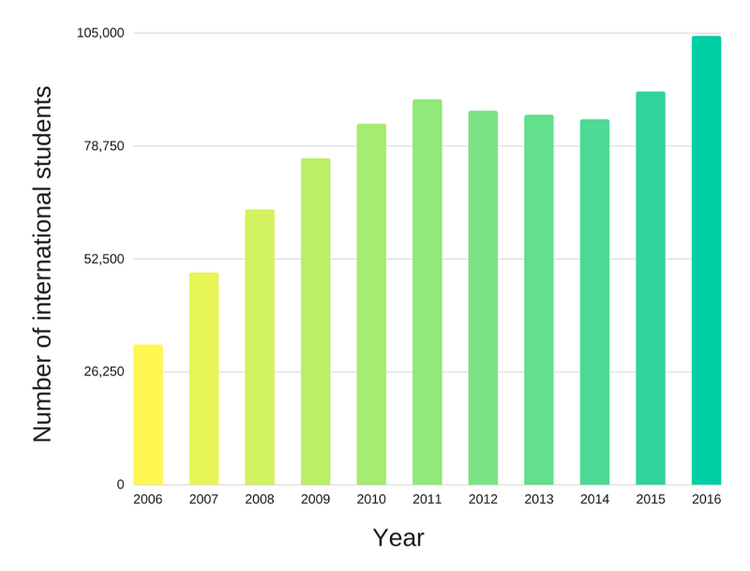
Though foreign students make up only about 1/8 of foreigners living in Korea (with the rest employed here in some capacity), this number has grown exponentially over the past ten years. The graph below illustrates this trend:
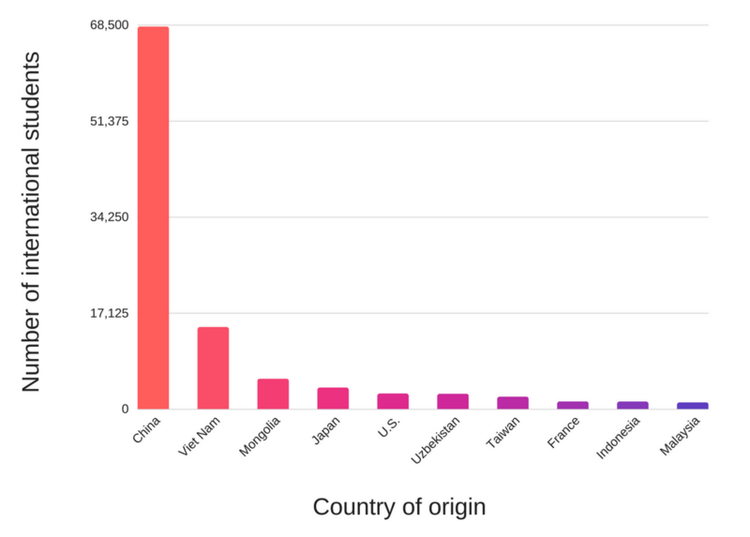
Students are from diverse countries, which means the languages and cultures they bring to Korea present a challenge. For example, students came from the following top ten countries in 2017. (Check it out — the countries of origin may surprise you! I see you, Uzbekistan):
Why are there more students in Korea these days?
The reason for this increase, beyond Korea’s soft power hallyu wave that captured foreign hearts and minds through the irresistible pull of K-Dramas, K-pop, and Korean cuisine, can be attributed to recent government efforts to better support foreign students who wish to come here to study. Beyond generous scholarships such as the Korean Government Scholarship Program (KGSP), which funds the studies and basic living costs of undergraduate and graduate students in Korea, the government has also loosened restrictions to make it easier for students to look for a job after graduation, increased the number of English-language programs (especially in STEM), and created new regulations to help universities create courses of study exclusively for international students. (Source: ICEF Monitor)
With more and more international students choosing to come for higher education, what does this mean for their options for healthcare in Korea? In other words, how can young students access all that the Korean healthcare system has to offer on the small budget most students have while studying abroad for the short term or long term?
Why is insurance for healthcare in Korea mandatory for students? What should students do?
Students tend to fall into the group of people who may want to risk not having insurance . You know how it goes – “I’m young and healthy, so I’m sure it will be fine!” However, the Korean government passed a law in 2015 that makes it compulsory for students, even international ones, to have insurance. (Source: The Korea Herald) So, to talk about healthcare funding for students in Korea means we must talk about the insurance itself as a mandatory expense in the process of accessing medical services.
One answer is to register with a National Health Insurance (NHI) plan, which is open to all residents of Korea, regardless of citizenship status. Broadly, it covers everything from “ health check-ups, tests and diagnosis, treatments, surgeries, preventive care, hospitalization, nursing, rehabilitation and transportation.” (Source: SmartExpat) If you are planning on staying in the country longer than 90 days (or 3 months) as a foreigner, you must apply for an Alien Registration Card (ARC).
As funny as the name sounds, you need your ARC for everything here in Korea — buying a monthly phone plan, paying for healthcare, and even reserving movie tickets! Insurance is no different. Once you have your ARC in hand (usually after several visits to the local Immigration Office near you, but that’s a very long, complicated kind of story best saved for a future post), you can sign up for the NHI and have access to the same benefits as Korean citizens.
What is the Korean National Health Insurance plan?
People applying for the National Health Insurance plans fall into one of two categories — “employee coverage” and “self-employed coverage,” with students falling into the latter category. (Source: Korea4Expats) Though valid for anyone living in Korea, NHI does not cover travel outside of Korea, so it is important to bear that in mind when traveling while you study or work abroad here. (Soure: Korea4Expats) As far as the pricing goes, it varies depending on your status and why you’ve come to Korea. Students are only expected to pay about 50% of the cost of healthcare, for example (Source: National Health Insurance System) though this may vary depending on the procedure or treatment needed.
So why do people buy private health insurance in Korea?
For that reason, some residents choose to buy additional private insurance to supplement NHI coverage for healthcare in Korea. For example, foreigners in particular often tend to buy private insurance for the following reasons (Source: WorknPlay):
1. They need to undergo a procedure that is not covered by NHI plans. Of course, it makes sense that NHI doesn’t cover plastic surgery, but it also may not cover services provided by “non-essential” doctors like chiropractors. Interestingly though, NHI does cover “traditional” Korean medicine as a treatment option.
2. They have children and/or chronic health issues that require many checkups, tests, procedures, etc.
3. They are not a resident — NHI is only valid for those staying 90 days or longer, so most tourists aren’t eligible for this plan, nor are those who are waiting to have their ARC processed by Immigration.
4. Universities also offer a cheap student insurance option sometimes. For example, students in the Graduate School of International Studies program at Ewha University can sign up for Dongbu Health insurance for cheap coverage. This policy covers many basic healthcare services to fulfill the government requirement that students have health insurance in Korea. Please check with your university to find out what options are available, including the possibility of receiving healthcare services on campus.
Navigating the National Health Insurance system
This all seems fairly straightforward, and as simple as visiting the nearest NHI office. However, trying to tease out the eligibility requirements, especially as a student, is…daunting, to say the least. These are screenshots from the NHI website regarding eligibility, to illustrate this unfortunate point:


We understand your frustration, folks. At Jivaka Care, we’ve seen friends go through this. Some of us have even been through this struggle ourselves!
How Jivaka Care can help
That’s why we’re writing this post. This is not the final answer to the questions you may have about insurance, funding, and other healthcare issues. This is the beginning of a conversation. We’ve started to make a list of questions that we’ll be working hard to answer. We want to provide you with comprehensive, well-researched information so you can navigate healthcare in Korea. For example, we’ll be tackling issues like these, based on the feedback we’ve received so far:
– Why do you have to go to certain pharmacies to fill a prescription after going to a clinic? How do you know which one to go to, and why does it work this way?
– What procedures will be covered by which insurance and why? How can you find out in advance?
– How do you fill an insurance claim after receiving healthcare in Korea?
– What specific procedures should you have private insurance for?
Though we’re not medical professionals ourselves, we can help you find medical information that’s specific to you. Figuring out your options for healthcare in Korea isn’t easy. We’ll help by doing our own research and translating Korean language sites like Naver. Sometimes the information you need may be buried deep in someone’s old blog post!
How to contact us
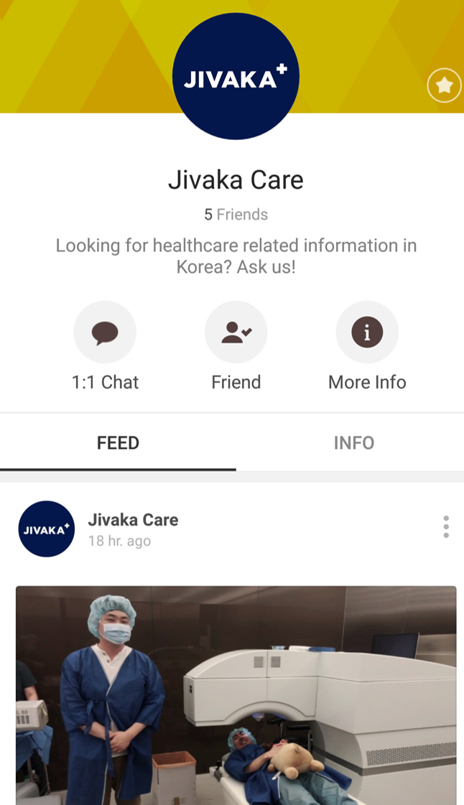
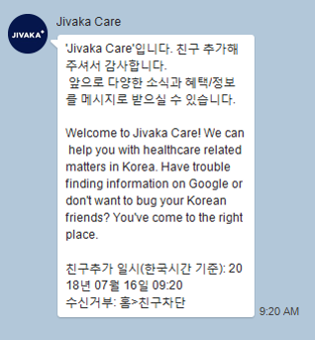
We know how important your health is to you, and it’s important to us too. So reach out to us on our website to ask about your questions, or even add us on KakaoTalk as a Plus Friend. We’ll be around to help you answer any and all of your questions about healthcare in Korea. For our KakaoTalk service, just search for “Jivaka Care” in the Contacts section of your account. You can also add us through this link, and ask us anything.
So drop us a line! Let’s work together to help you experience the best Korea has to offer during your time here.
Follow us on Facebook, Twitter, Instagram, and Youtube to stay up-to-date with our services and find answers to your health questions, or check out our website!